
【国画基本信息】
| 作者 | 吴琚 |
| 品名 | 书七言绝句图轴 |
| 朝代 | 宋朝 |
| 文件大小 | 18.01MB |
| 分辨率 | 300x300 |
| 像素大小 | 2120x2832 |
| 尺寸(CM) | 17.94x23.97 |
| 作品数量 | 1 |
| 作品收藏 | 台北故宫博物院 |
| 图片格式 | 默认提供TIF和JPG两个版本 |
基本数据
| 藏品类型 | 书法 |
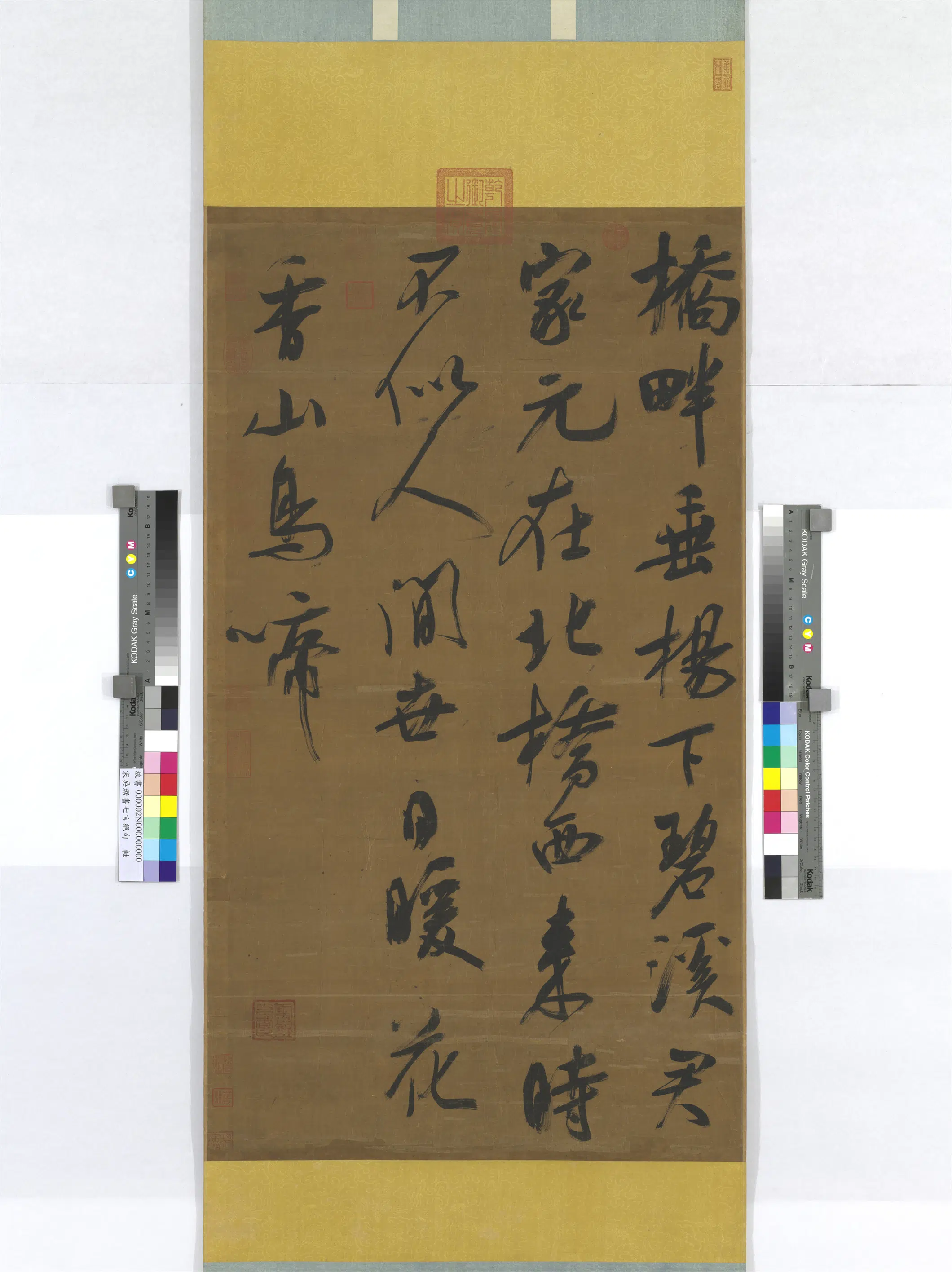
| 品名 | 宋吴琚书七言绝句 轴 Truncated Verse in Seven-characters |
| 分类 | 法书 |
| 作者 | 吴琚 |
| 书体 | 行书 |
| 数量 | 一轴 |
| 作品语文 | 汉文 |
| 释文 | 桥畔垂杨下碧溪。君家元在北桥西。来时不似人间世。日暖花香山鸟啼。 |
典藏尺寸
| 【位置】 | 【尺寸】(公分) |
| 本幅 | 98.6x55.3 |
质地
| 【质地位置】 | 【质地】 |
| 本幅 | 绢 |
参考数据
| 【类别】 | 【参考数据】 |
| 收藏着录 | 石渠宝笈初编(御书房),下册,页1092 |
| 收藏着录 | 故宫书画录(卷二),第一册,页2 |
| 内容简介(中文) | 吴琚(活动于十二世纪后半),开封人。他的父亲吴益是南宋高宗吴皇后之弟,母亲是秦桧的孙女。虽是外戚权贵之后,却并不自骄,诗文书法俱佳。 此幅七言绝句书自蔡襄诗,是少见的宋代挂轴书迹。吴字挺拔俊秀,结体和姿态都宗米芾,但是和北宋书家笔笔送到的工夫相较,吴琚的运笔快速强劲、行笔不时出现飞白,显示南宋书家对上下呼应与整体气势追求,甚于每一字的精工与锤炼。 |
| 内容简介(英文) | Wu Chu was a native of K'ai-feng, Honan. In 1173, he was appointed Controller-General of Hangchow and by 1195 had risen to the position of Military Commissioner of the Chen-an Troops. As the nephew of Emperor Kao-tsung (r. 1127-1162), he was often in attendance with Kao-tsung's son, Emperor Hsiao-tsung (r. 1162-1189), who often appreciated poetry and calligraphy with Wu. Wu Chu's calligraphy is fresh and spirited, his use of ink rich and thick. His brush strokes were done with such speed that white spaces were left behind in a technique known as "flying white." The entire work here appears as if done in a single breath, the characters of the poem flow like the notes on a sheet of music, while the characters fly about as if in a dance. Gazing at this work gives a sense of peace and tranquility. |
| 内容简介(中文) | 吴琚,生卒年不详,开封人。字居父,号云壑。其父吴益(公元一一二四-一一七一)为高宗吴皇后之弟。工翰墨,孝宗常召之论诗作字。历帅荆襄鄂三路,嘉泰二年(一二0二)迁少保,卒谥忠惠,有云壑集。 明董其昌评吴琚之书云:「琚书自米南宫芾外,一步不窥。」又云:「琚书似米元章,而峻峭过之。」观此书,果与董氏之言甚合。 |
| 内容简介(英文) | Wu Chu (style name Chu-fu, sobriquet Yun-ho, and posthumous name Chung-hui) was a native of K'ai-feng. His father, Wu I (1124-1171), was the younger brother of Empress Wu, Kao-tsung's consort. Wu Chu served as an official at the provincial level and was eventually given the prestigious title of Junior Guardian. His written works are compiled in the Collected Works of Yun-ho. The Ming critic Tung Ch'i-ch'ang (1555-1636) once said of Wu Chu’s calligraphy that "Chu’s calligraphy is taken from that of Mi Fu—not that of anyone else." He also said, "Chu’s calligraphy resembles Mi Fu's, but is |
