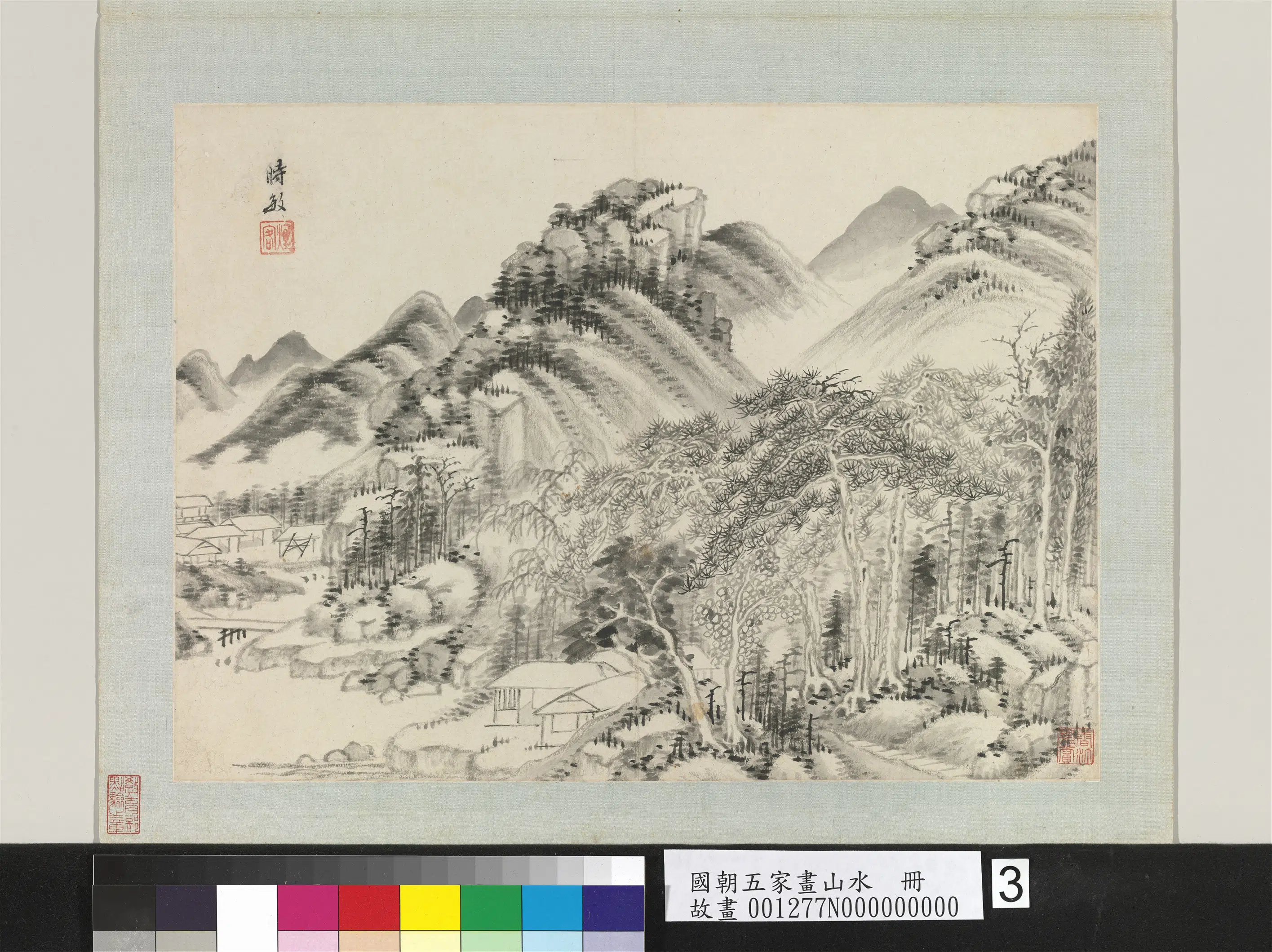
| 内容简介(英文) | Wang Shih-min (style name Sun-chih; sobriquet Yen-k’e; and called himself Hsi-lu lao-jen, Hsi-t’ien chu-jen, and Kuei-ts’un lao-nung) was a native of T’ai-ch’ang, Kiangsu. Early in the reign of the Ch’ung-chen emperor (r. 1628-1644), Wang Shih-min was awarded a post in the Court of Imperial Sacrifices. He was extraordinarily gifted and profound, refined, and erudite. He was skilled at poetry and literature, and he excelled at calligraphy, especially clerical script. His forte, however, was painting. Wang Shih-min possessed a large collection of famous art works and spared no amount of money to purchase them. His rendering of Huang Kung-wang’s (1269-1354) style was marvelous. In his early years, Wang exhaustively studied the essence of Huang’s style, so that in his later years Wang’s style was spiritually transformed. Depicted in this painting are mountain streams, flowing water, assorted trees, dwellings, fields, hills, but no sign of human presence. Wang Shih-min applied his brush freely in this work to color and dot. The monochrome ink appears to be dripping wet and spiritually exhilarated. The brushwork and scenery both attain the spirit consonance of Huang Kung-wang’s style. |