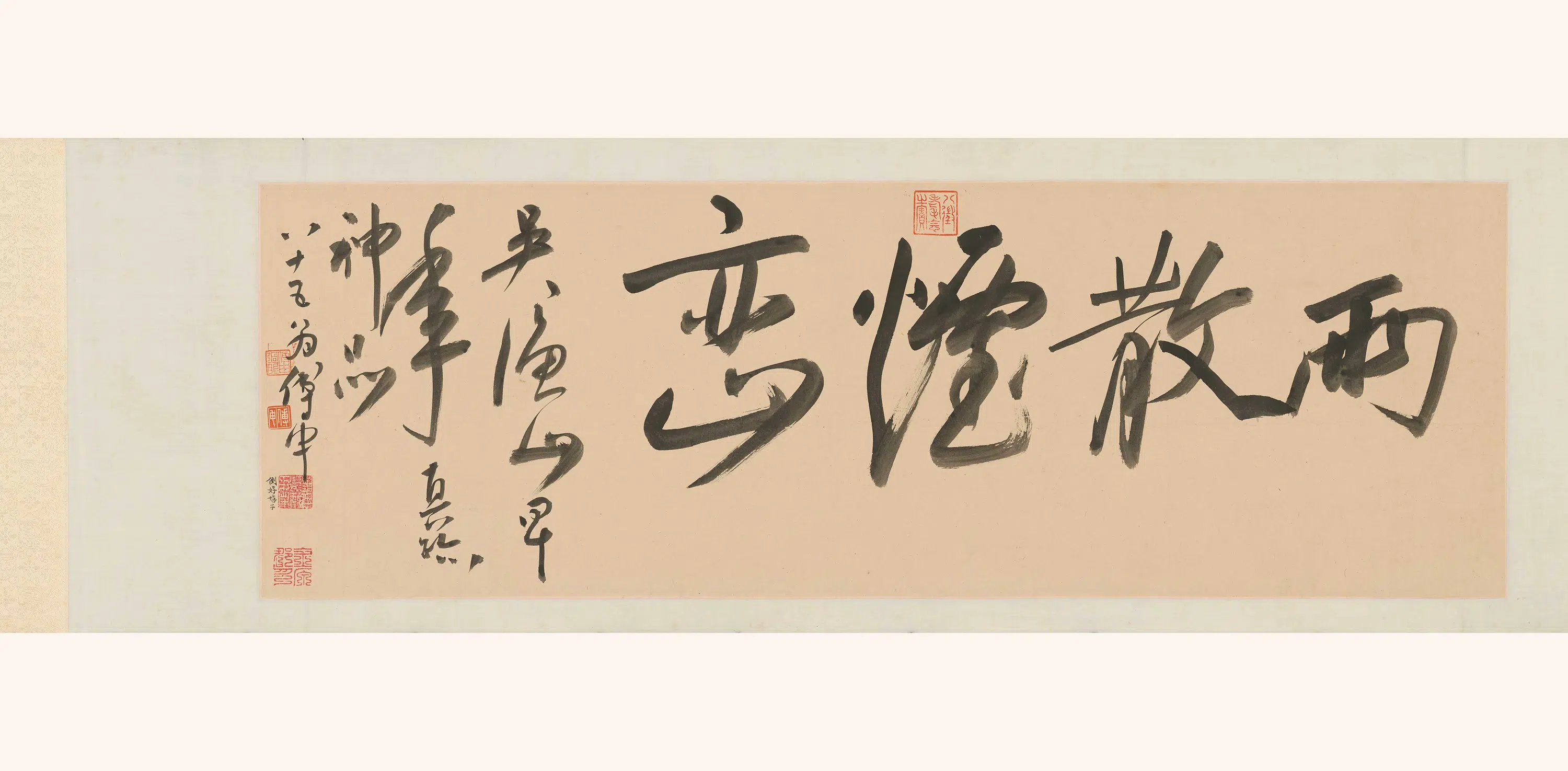
| 作者 | 吴历 |
| 品名 | 雨散烟峦卷 |
| 朝代 | 清代 |
| 文件大小 | 137.93MB |
| 分辨率(DPI) | 72x72 |
| 像素大小 | 21627x2126 |
| 尺寸(CM) | 762.95x75.0 |
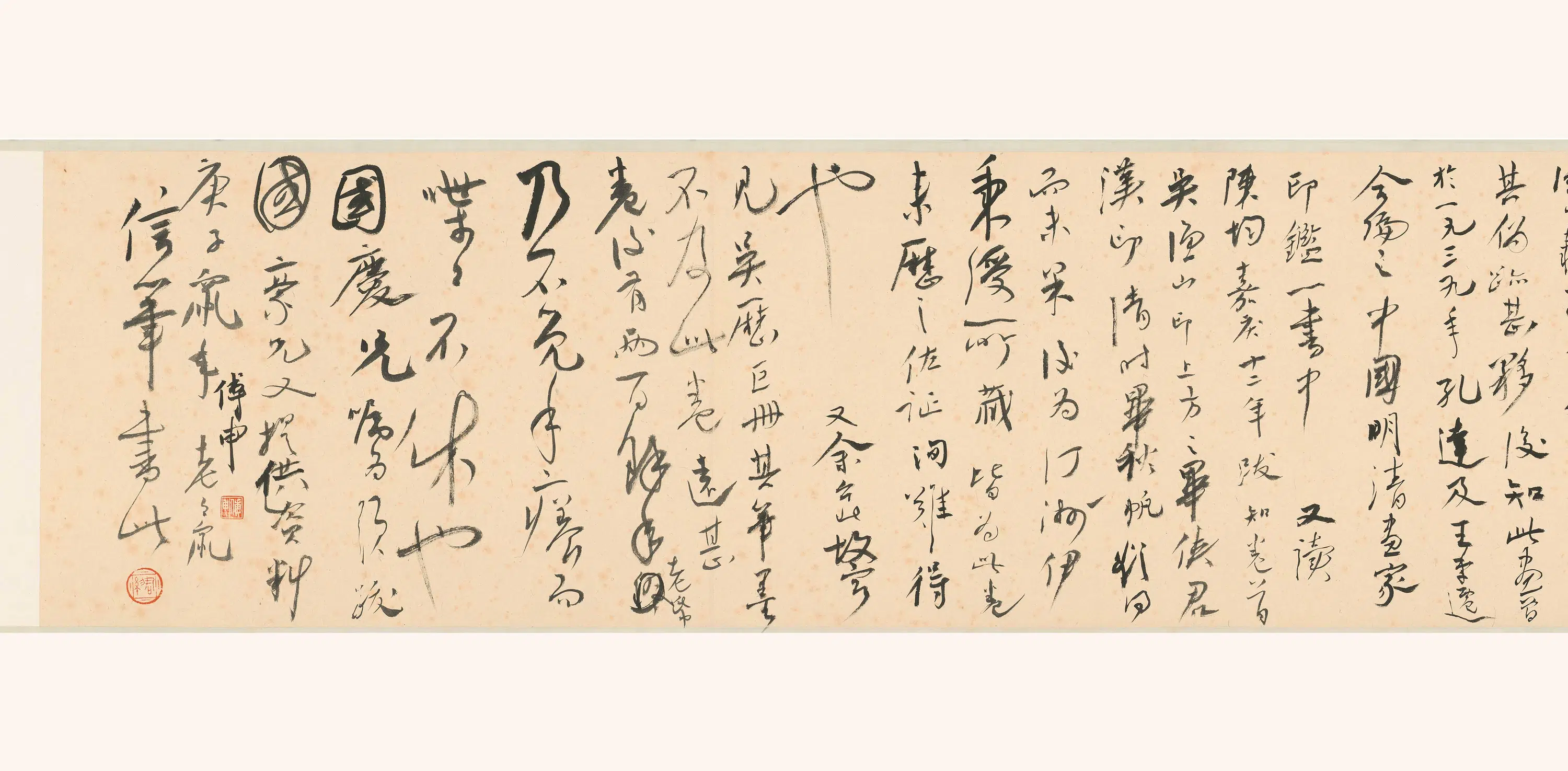
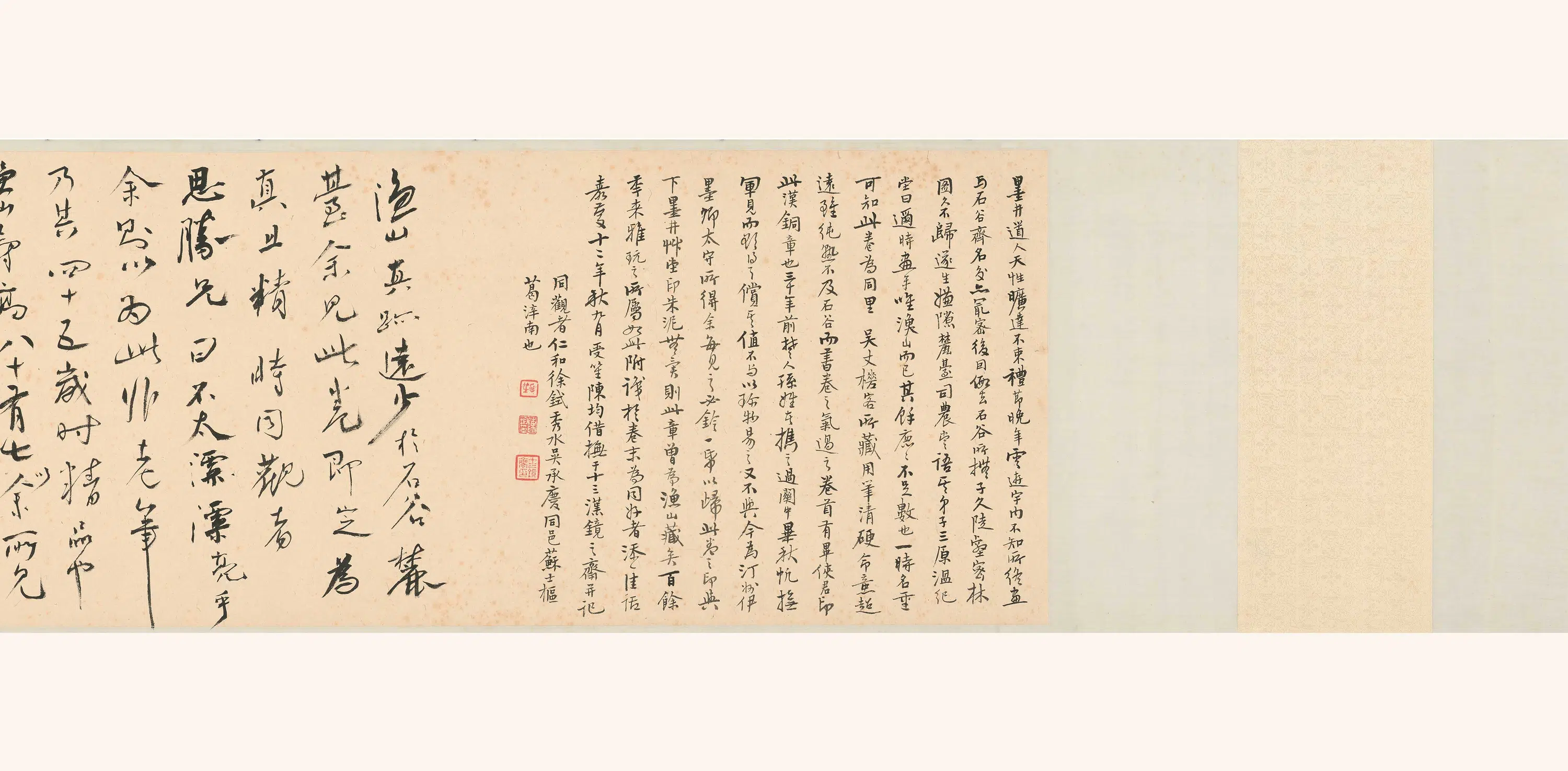
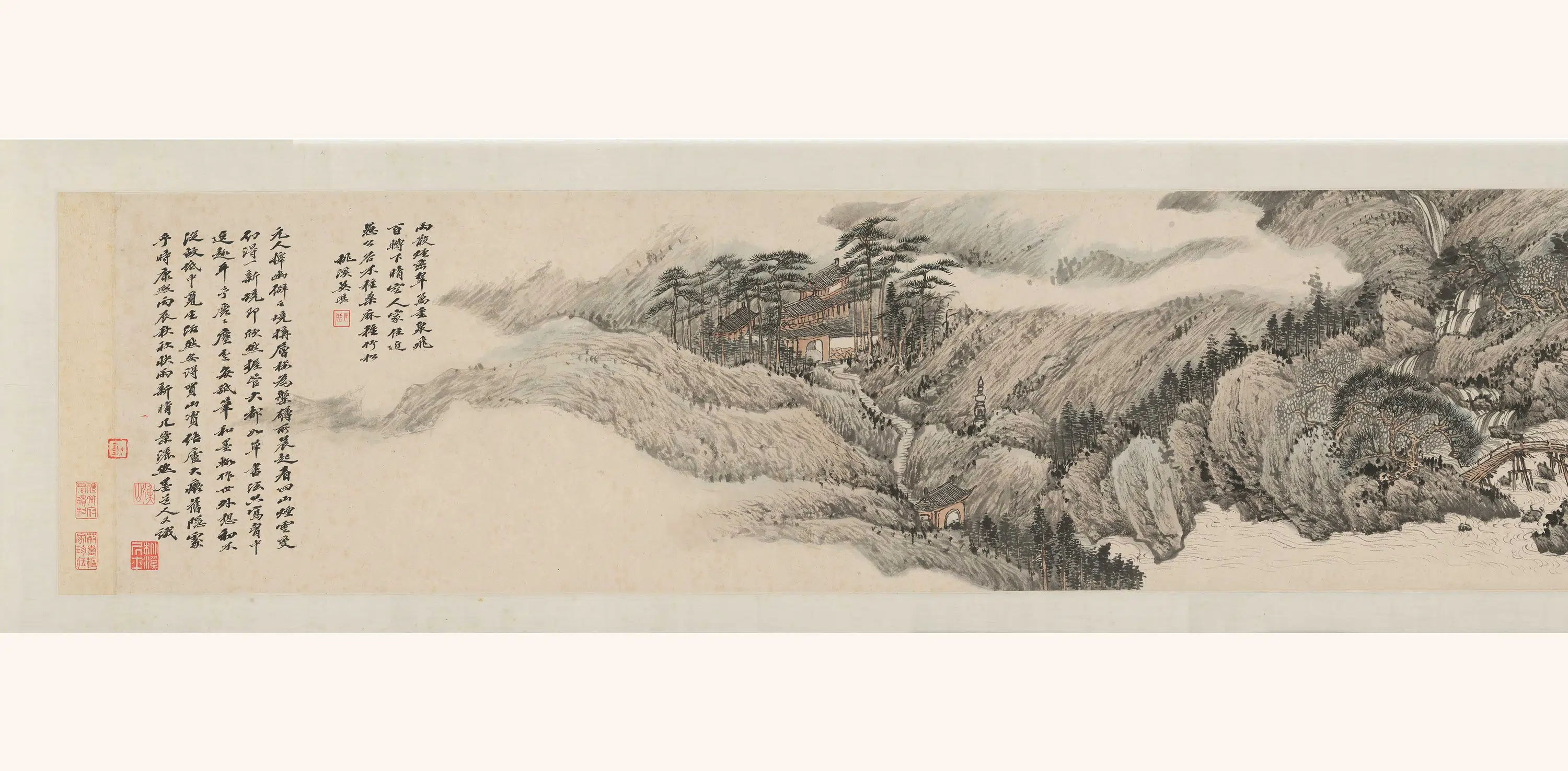
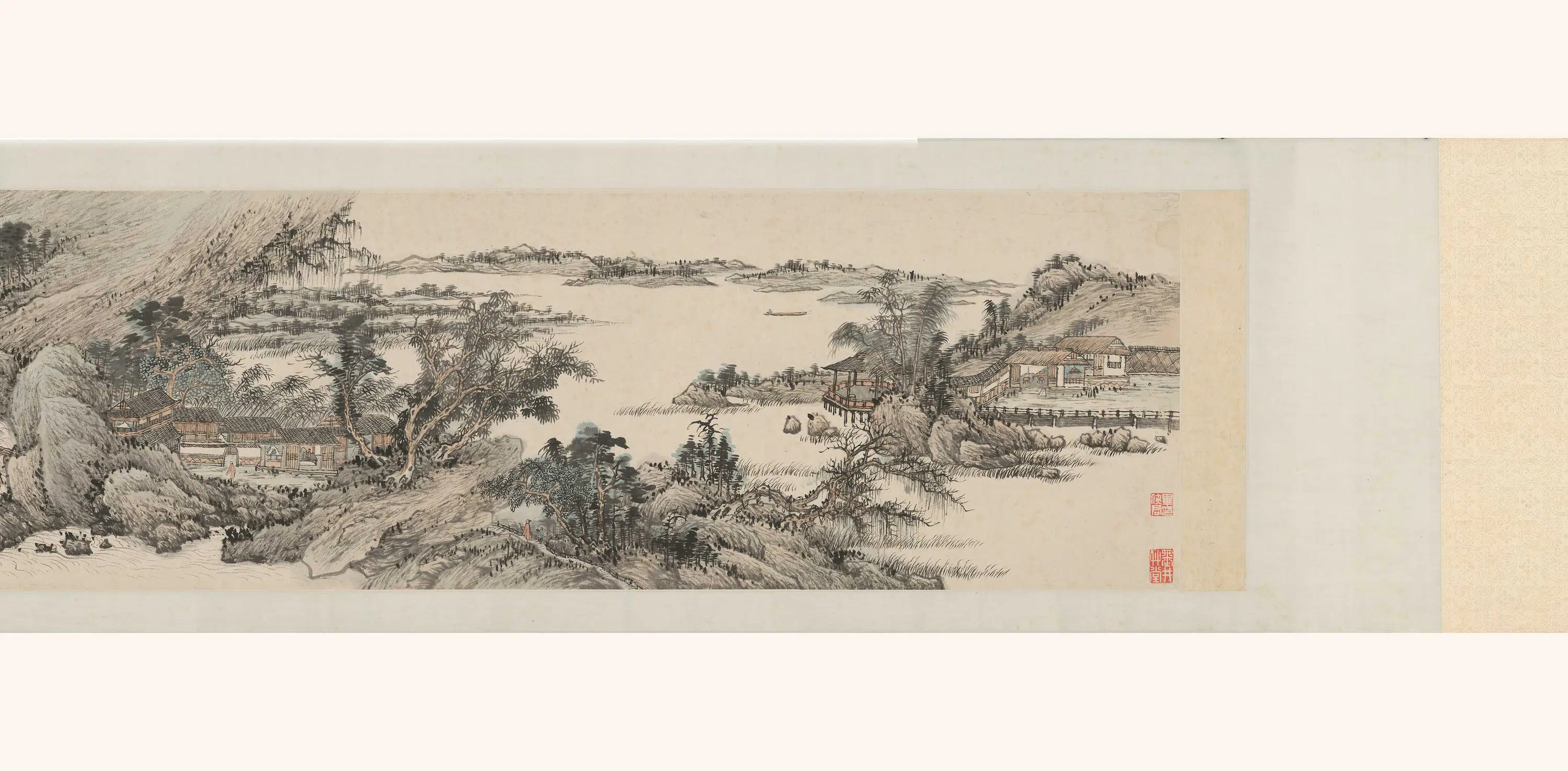
| 解题 | (傅申引首)雨散煙巒,吳漁山早年真跡神品,八十五翁傅申 鈐印:傅申過眼、傅申、八徵耄念之寶 (吳歷款識)雨散煙巒翠萬重,泉飛百轉下晴空。人家住近愚公谷,不種桑麻種竹松。桃溪吳歷。 元人擇幽僻之境構層樓為盤礴所,晨起看四山煙雲變幻,得一新境即欣然握管,大都如草書法,只寫胸中逸趣耳。 予鹿鹿塵坌,每舐筆和墨,輒作世外想,初不從故紙中覓生活,然安得買山資結廬大癡舊隱處乎?時康熙丙辰秋,快雨新晴,幾案灑然。墨道人又識。 鈐印:吳歷、漁山、桃溪居士 (陳均跋):墨井道人天性曠達,不束禮節。晚年雲遊宇內,不知所終。畫與石谷齊名,交亦最密。後因假去石谷所撫子久《陡壑密林圖》久不歸,遂生嫌隙。麓台司農嘗語其弟子三原溫紀堂曰:邇時畫手唯漁山而已,其餘鹿鹿,不足數也。一時名重可知。此卷為同里吳丈槎客所藏,用筆清硬,命意超遠,雖純熟不及石谷,而書卷之氣過之。卷首有「畢俠君印」,此漢銅章也。三十年前,楚人孫姓者携之過關中,畢秋帆撫軍見而欲得之,償其值不與,以珍物易之又不與,今為汀州伊墨卿太守所得,余每見之,必鈐一紙以歸。此卷之印與下「墨井草堂」印朱泥無異,則此章曾為漁山藏矣。百餘年來,雅玩之所屬如此,附識於卷末,為同好者添一佳話。嘉慶十二年(1807)秋九月,受笙陳均借撫於十三漢鏡之齋並記。同觀者仁和徐鉽、秀水吳承慶、同邑蘇士樞、葛㳯南也。 鈐印:受笙、陳均印、十三鏡齋 (傅申跋)漁山真跡遠少於石谷、麓臺,余見此卷即定為真且精。時同觀者思勝兄曰:「不太漂亮乎?」余以為非老筆,乃其四十五歲時精品也。漁山壽高八十有七,以余所見其偽跡甚夥,後知此畫曾於一九三九年孔達及王季遷合編之《中國明清畫家印鑑》一書中。又讀陳均嘉慶十二年跋,知卷首吳漁山印上方之畢俠君漢印,清時畢秋帆欲得而未果,後為汀州伊秉綬所藏,皆為此卷來歷之佐證,洵難得也。 又余台北故宮見吳歷巨冊,其筆墨不及此卷甚遠。卷後有兩百餘年老紙,乃不覺手癢而喋喋不休也。國慶兄囑為題跋,國豪兄又提供資料。庚子鼠年,傅申老老鼠信筆書此。 鈐印:傅申、君約 賞析 曹淑娟教授賞析: 吳漁山《雨散煙巒卷》以山水畫卷寄寓園居之思,卷上七絕與題識說明畫意所在,也提供閱覽者觀看的視角。詩句前半言快雨新晴後的山景,「雨散煙巒翠萬重,泉飛百轉下晴空」,結合畫幅觀察,遠水平泛,山體才是主景,山勢崛嶇奔突,中有流泉飛瀑,峰巒間煙雲迴環,似有無窮變幻,蓄勢待出。後半言山中人家,「人家住近愚公谷,不種桑麻種竹松」,「愚公谷」是晚明無錫鄒迪光所建,巧妙援引惠山與二泉水入園,漁山借以指稱山水中的園林。明代早期莊園中多農圃果園,後期商品經濟發達,多為觀賞性植栽所取代,竹與松具有堅貞品格的隱喻傳統,尤為文人所喜愛。畫中在山水間安置人家,並刻意畫出幾株老松、一片竹林。題識進一步指出:山水中樓居,可貴之處在於提供盤礴之所,可以領略山水之間的欣趣,且有內在心境的應答聯結:「得一新境即欣然握管,大都如草書法,只寫胸中逸趣耳」。他所喜愛的元人畫家,黃公望有富春、虞山舊居,倪瓚有清閟閣,黃公望晚年歸於虞山,對漁山而言尤為親近,題識流露「安得買山資結廬大癡舊隱處乎」的嚮往,此畫可說是漁山舐筆和墨,「作世外想」,體認前輩畫家園居生活心靈境界的致敬之作。 此畫的畫意為隱居山水,是吳歷心目中的世外桃源「愚公谷」之境,王維曾有愚公谷詩:「借問愚公谷,與君聊一尋。不尋翻到谷,此谷不離心。行處曾無險,看時豈有深。寄言塵世客,何處欲歸林。」,表述了歸隱山林的心志。〈雨散煙巒圖〉以元人黃公望的筆法而成,吳歷在此畫的題跋說道畫此圖的心態是以草書法寫出胸中的逸氣,而這句話正是倪瓚的名言。可見吳歷一生畫學功力盡在元代。然而在山石的石青設色,亦可見到沈周的遺緒。此畫後有清代嘉慶十三年陳均的一則有歷史典故的題跋,提到在清初時王翬和吳歷當時俱稱繪畫名手,吳歷功力不及王翬,但氣質過之。又二人本為至交,後來王翬向吳歷借模黃公望的〈陡壑密林圖〉未還,二人遂生嫌隙。吳歷的〈雨散煙巒圖〉在清代為海寧大藏書家吳騫(1733-1813)「拜經樓」所有,或許是吳歷所畫的「愚公谷」和吳騫的號「愚谷」相呼應吧。在此畫卷首下方有一「畢俠君印」漢印,本為吳歷所藏所鈐。有趣的是,「畢俠君印」後來竟為畢沅、伊秉綬相繼所有,陳均在伊秉綬與吳歷〈雨散煙巒圖〉均見到此印,於是記載此一段墨事因緣。 Henning von Mirbach, Research assistant, HCS Calligraphy Arts Foundation (米翰寧 何創時書法基金會 副研究員 ) 賞析 : Opening Wu Li’s handscroll on the right, the painting starts with a country house nestled among low mountains to which a pavilion overlooking a lake also belongs. On the other side of the lake, a cluster of houses forms an estate that is situated at the foot of a steeply rising mountain from which a roaring waterfall cascades. Visitors to this landscape can traverse the waterfall by means of a bridge before entering a cloud-and-mist enshrouded mountainous area. The painting finds its end at a third cluster of houses, this time a bit more luxurious as indicated by the two-storied buildings and a stately gate. Wu Li painted Dispersing Rains amid Cloudy Mountains in a style that strongly recalls the manners of Huang Gongwang 黃公望 (1269–1354) and Wang Meng 王蒙 (1298–1385). Especially the texture strokes used to give the mountains a sense of spatiality hark back to these iconographic Yuan dynasty (1279–1368) artists. This is befitting given that Wu Li is known as one of the orthodox masters of the early Qing who, in following the teachings of Dong Qichang 董其昌 (1555–1636), took pride in emulating antique styles. But Wu Li also cites the Ming dynasty (1368–1644) artist Shen Zhou 沈周 (1427–1509) when he employs light hues of blue and reddish-brown to describe the architecture. These color hues lend a particular charm to Dispersing Rains amid Cloudy Mountains for which Wu Li is otherwise also known in works such as his famous Spring Scene of Lake and Heaven (Hutian chunshe tu 湖天春色圖) in the Shanghai Museum.(1) Towards the end of the painting, Wu Li first inscribed a poem and then a longer inscription in which he indicates that the painting was done on the qiushe 秋社 day in the bingchen 丙辰 year of the Kangxi 康熙 reign (1661–1722), which corresponds to autumn 1676.(2) Dispersing Rains amid Cloudy Mountains was thus painted approximately three months after Spring Scene of Lake and Heaven. The inscribed poem offers insights into the interpretative horizon of the scroll. It reads: 雨散煙巒翠萬重, After rain, misty mountains extend their kingfisher green in myriads of layers, 泉飛百轉下晴空。 Flying in hundreds of whirls, a waterfall descends from the clear sky. 人家住近愚公谷, Several households nestled nearby the Valley of Master Foolish, 不種桑麻種竹松。 Instead of growing mulberry trees and hemp, they all plant bamboo and pine trees. The dispersing clouds in the second half of the painting echo the mountain-enshrouding mists rising after a rainfall described in the poem’s first line. The waterfall of the second line is evidently placed in a very prominent position in Wu Li’s scroll. With the Valley of Master Foolish (Yugong gu 愚公谷) mentioned in the poem’s third line, Wu Li conjures up a canonical image of reclusion and thus gives the handscroll its definitive interpretive horizon in which the houses become abodes for seclusive living and the depicted humans stand in for the recluse. The loci classici for this image are Liu Xiang’s 劉向 (77–6 BCE) Garden of Stories (Shuoyuan 說苑),(3) and Wang Wei’s 王維 (699–759) “The Valley of Master Foolish: Three Poems” (“Yugong gu san shou” 愚公谷三首).(4) In the story recorded by Liu Xiang, the Duke of Qi asks an elderly recluse why he has given away a horse under pressure without realizing that he himself, as the politically responsible leader, should create circumstances in which bullying of weak members of society is not occurring and in which people do not have to go into reclusion. In Wang Wei’s poem, the narrator does not need to seek the valley because, in the translation of Paul Rouzer, “this valley isn’t separate from the mind.”(5) Once alerted to this reading, the fourth line of the poem becomes understandable, too. Not growing “mulberry trees and hemp” (sangma), a traditional way of describing agricultural activities,(6) the inhabitants of Wu Li’s landscape are said to grow bamboo and pine trees instead. These are traditionally connotated with the unbending character of virtuous gentlemen, the literati (wenren 文人). Bamboo can bend under pressure while evergreen pine trees can resist winter’s harshness. Pictorially, Wu Li takes up these themes by painting bamboos surrounding the estate at the foot of the mountain right to the waterfall, while pine trees wall off the estate to the left of the waterfall. Wu Li’s Dispersing Rains amid Cloudy Mountains, then, embodies the literati ideal of living in reclusion and not being concerned with worldly affairs. However, the painting might depict more than only an abstract ideal of reclusion. Circumstantial evidence may corroborate the hypothesis, first advanced by Prof. Tsao Shu-chuan 曹淑娟, that the painting represents the country estate Valley of Master Foolish (Yugong gu 愚公谷) that the late Ming literati Zou Diguang 鄒迪光 (1574 jinshi) had built in Wuxi 無錫, Jiangsu 江蘇 province. Zou Diguang had authored the Annals of Valley of Master Foolish (Yugong gu sheng 愚公谷乗) and sported the sobriquet (hao 號) Yugu 愚谷, thus underlining the importance that this house held for him. While it is not clear whether Wu Li had visited the estate, we know that Wu Li had visited Wuxing.(7) Other famous early late-Ming and early-Qing literati such as Zhang Dai 張岱 (1597–1648?) and Chen Weisong 陳維崧 (1626–1682) were all aware of the estate belonging to Zou Diguang.(8) In other words, Zou’s estate was widely known among leading literati of the late Ming and early Qing, thus making it likely that Wu Li also was familiar with it. In particular the pictorial detail of the roaring waterfall may indicate that Wu Li was indeed having Zou Diguang’s estate in mind when painting Dispersing Rains amid Cloudy Mountains. While Liu Xiang’s Valley of Master Foolish in the Garden of Stories is described as being entirely flat, Wu Li has captured a cascading waterfall, reinforced by fresh rainfall. This atmosphere corresponds to Zou Diguang’s own description of swelling waters at his estate in a poem entitled “Viewing a Spring after Rain at Valley of Master Foolish.” Zou’s poem reads: 雨脚一淋漓, Once raindrops drench [the earth], 水勢遂縱送。 The water levels rise [as quick] as galloping arrows and spurring birds. 風泉互勞攘, Wind and spring stroke each other, 水石兩倥傯。 While waters and rocks are in great haste. 歷堰曾幾何, It has flown through many weirs, 為壑固已衆。 And has created plenty of |
| 作品数量 | 1 |
| 作品收藏 | 何创时书法艺术博物馆 |
| 释文、题跋资料 | (傅申引首)雨散煙巒,吳漁山早年真跡神品,八十五翁傅申 鈐印:傅申過眼、傅申、八徵耄念之寶 (吳歷款識)雨散煙巒翠萬重,泉飛百轉下晴空。人家住近愚公谷,不種桑麻種竹松。桃溪吳歷。 元人擇幽僻之境構層樓為盤礴所,晨起看四山煙雲變幻,得一新境即欣然握管,大都如草書法,只寫胸中逸趣耳。 予鹿鹿塵坌,每舐筆和墨,輒作世外想,初不從故紙中覓生活,然安得買山資結廬大癡舊隱處乎?時康熙丙辰秋,快雨新晴,幾案灑然。墨道人又識。 鈐印:吳歷、漁山、桃溪居士 (陳均跋):墨井道人天性曠達,不束禮節。晚年雲遊宇內,不知所終。畫與石谷齊名,交亦最密。後因假去石谷所撫子久《陡壑密林圖》久不歸,遂生嫌隙。麓台司農嘗語其弟子三原溫紀堂曰:邇時畫手唯漁山而已,其餘鹿鹿,不足數也。一時名重可知。此卷為同里吳丈槎客所藏,用筆清硬,命意超遠,雖純熟不及石谷,而書卷之氣過之。卷首有「畢俠君印」,此漢銅章也。三十年前,楚人孫姓者携之過關中,畢秋帆撫軍見而欲得之,償其值不與,以珍物易之又不與,今為汀州伊墨卿太守所得,余每見之,必鈐一紙以歸。此卷之印與下「墨井草堂」印朱泥無異,則此章曾為漁山藏矣。百餘年來,雅玩之所屬如此,附識於卷末,為同好者添一佳話。嘉慶十二年(1807)秋九月,受笙陳均借撫於十三漢鏡之齋並記。同觀者仁和徐鉽、秀水吳承慶、同邑蘇士樞、葛㳯南也。 鈐印:受笙、陳均印、十三鏡齋 (傅申跋)漁山真跡遠少於石谷、麓臺,余見此卷即定為真且精。時同觀者思勝兄曰:「不太漂亮乎?」余以為非老筆,乃其四十五歲時精品也。漁山壽高八十有七,以余所見其偽跡甚夥,後知此畫曾於一九三九年孔達及王季遷合編之《中國明清畫家印鑑》一書中。又讀陳均嘉慶十二年跋,知卷首吳漁山印上方之畢俠君漢印,清時畢秋帆欲得而未果,後為汀州伊秉綬所藏,皆為此卷來歷之佐證,洵難得也。 又余台北故宮見吳歷巨冊,其筆墨不及此卷甚遠。卷後有兩百餘年老紙,乃不覺手癢而喋喋不休也。國慶兄囑為題跋,國豪兄又提供資料。庚子鼠年,傅申老老鼠信筆書此。 鈐印:傅申、君約 賞析 曹淑娟教授賞析: 吳漁山《雨散煙巒卷》以山水畫卷寄寓園居之思,卷上七絕與題識說明畫意所在,也提供閱覽者觀看的視角。詩句前半言快雨新晴後的山景,「雨散煙巒翠萬重,泉飛百轉下晴空」,結合畫幅觀察,遠水平泛,山體才是主景,山勢崛嶇奔突,中有流泉飛瀑,峰巒間煙雲迴環,似有無窮變幻,蓄勢待出。後半言山中人家,「人家住近愚公谷,不種桑麻種竹松」,「愚公谷」是晚明無錫鄒迪光所建,巧妙援引惠山與二泉水入園,漁山借以指稱山水中的園林。明代早期莊園中多農圃果園,後期商品經濟發達,多為觀賞性植栽所取代,竹與松具有堅貞品格的隱喻傳統,尤為文人所喜愛。畫中在山水間安置人家,並刻意畫出幾株老松、一片竹林。題識進一步指出:山水中樓居,可貴之處在於提供盤礴之所,可以領略山水之間的欣趣,且有內在心境的應答聯結:「得一新境即欣然握管,大都如草書法,只寫胸中逸趣耳」。他所喜愛的元人畫家,黃公望有富春、虞山舊居,倪瓚有清閟閣,黃公望晚年歸於虞山,對漁山而言尤為親近,題識流露「安得買山資結廬大癡舊隱處乎」的嚮往,此畫可說是漁山舐筆和墨,「作世外想」,體認前輩畫家園居生活心靈境界的致敬之作。 此畫的畫意為隱居山水,是吳歷心目中的世外桃源「愚公谷」之境,王維曾有愚公谷詩:「借問愚公谷,與君聊一尋。不尋翻到谷,此谷不離心。行處曾無險,看時豈有深。寄言塵世客,何處欲歸林。」,表述了歸隱山林的心志。〈雨散煙巒圖〉以元人黃公望的筆法而成,吳歷在此畫的題跋說道畫此圖的心態是以草書法寫出胸中的逸氣,而這句話正是倪瓚的名言。可見吳歷一生畫學功力盡在元代。然而在山石的石青設色,亦可見到沈周的遺緒。此畫後有清代嘉慶十三年陳均的一則有歷史典故的題跋,提到在清初時王翬和吳歷當時俱稱繪畫名手,吳歷功力不及王翬,但氣質過之。又二人本為至交,後來王翬向吳歷借模黃公望的〈陡壑密林圖〉未還,二人遂生嫌隙。吳歷的〈雨散煙巒圖〉在清代為海寧大藏書家吳騫(1733-1813)「拜經樓」所有,或許是吳歷所畫的「愚公谷」和吳騫的號「愚谷」相呼應吧。在此畫卷首下方有一「畢俠君印」漢印,本為吳歷所藏所鈐。有趣的是,「畢俠君印」後來竟為畢沅、伊秉綬相繼所有,陳均在伊秉綬與吳歷〈雨散煙巒圖〉均見到此印,於是記載此一段墨事因緣。 Henning von Mirbach, Research assistant, HCS Calligraphy Arts Foundation (米翰寧 何創時書法基金會 副研究員 ) 賞析 : Opening Wu Li’s handscroll on the right, the painting starts with a country house nestled among low mountains to which a pavilion overlooking a lake also belongs. On the other side of the lake, a cluster of houses forms an estate that is situated at the foot of a steeply rising mountain from which a roaring waterfall cascades. Visitors to this landscape can traverse the waterfall by means of a bridge before entering a cloud-and-mist enshrouded mountainous area. The painting finds its end at a third cluster of houses, this time a bit more luxurious as indicated by the two-storied buildings and a stately gate. Wu Li painted Dispersing Rains amid Cloudy Mountains in a style that strongly recalls the manners of Huang Gongwang 黃公望 (1269–1354) and Wang Meng 王蒙 (1298–1385). Especially the texture strokes used to give the mountains a sense of spatiality hark back to these iconographic Yuan dynasty (1279–1368) artists. This is befitting given that Wu Li is known as one of the orthodox masters of the early Qing who, in following the teachings of Dong Qichang 董其昌 (1555–1636), took pride in emulating antique styles. But Wu Li also cites the Ming dynasty (1368–1644) artist Shen Zhou 沈周 (1427–1509) when he employs light hues of blue and reddish-brown to describe the architecture. These color hues lend a particular charm to Dispersing Rains amid Cloudy Mountains for which Wu Li is otherwise also known in works such as his famous Spring Scene of Lake and Heaven (Hutian chunshe tu 湖天春色圖) in the Shanghai Museum.(1) Towards the end of the painting, Wu Li first inscribed a poem and then a longer inscription in which he indicates that the painting was done on the qiushe 秋社 day in the bingchen 丙辰 year of the Kangxi 康熙 reign (1661–1722), which corresponds to autumn 1676.(2) Dispersing Rains amid Cloudy Mountains was thus painted approximately three months after Spring Scene of Lake and Heaven. The inscribed poem offers insights into the interpretative horizon of the scroll. It reads: 雨散煙巒翠萬重, After rain, misty mountains extend their kingfisher green in myriads of layers, 泉飛百轉下晴空。 Flying in hundreds of whirls, a waterfall descends from the clear sky. 人家住近愚公谷, Several households nestled nearby the Valley of Master Foolish, 不種桑麻種竹松。 Instead of growing mulberry trees and hemp, they all plant bamboo and pine trees. The dispersing clouds in the second half of the painting echo the mountain-enshrouding mists rising after a rainfall described in the poem’s first line. The waterfall of the second line is evidently placed in a very prominent position in Wu Li’s scroll. With the Valley of Master Foolish (Yugong gu 愚公谷) mentioned in the poem’s third line, Wu Li conjures up a canonical image of reclusion and thus gives the handscroll its definitive interpretive horizon in which the houses become abodes for seclusive living and the depicted humans stand in for the recluse. The loci classici for this image are Liu Xiang’s 劉向 (77–6 BCE) Garden of Stories (Shuoyuan 說苑),(3) and Wang Wei’s 王維 (699–759) “The Valley of Master Foolish: Three Poems” (“Yugong gu san shou” 愚公谷三首).(4) In the story recorded by Liu Xiang, the Duke of Qi asks an elderly recluse why he has given away a horse under pressure without realizing that he himself, as the politically responsible leader, should create circumstances in which bullying of weak members of society is not occurring and in which people do not have to go into reclusion. In Wang Wei’s poem, the narrator does not need to seek the valley because, in the translation of Paul Rouzer, “this valley isn’t separate from the mind.”(5) Once alerted to this reading, the fourth line of the poem becomes understandable, too. Not growing “mulberry trees and hemp” (sangma), a traditional way of describing agricultural activities,(6) the inhabitants of Wu Li’s landscape are said to grow bamboo and pine trees instead. These are traditionally connotated with the unbending character of virtuous gentlemen, the literati (wenren 文人). Bamboo can bend under pressure while evergreen pine trees can resist winter’s harshness. Pictorially, Wu Li takes up these themes by painting bamboos surrounding the estate at the foot of the mountain right to the waterfall, while pine trees wall off the estate to the left of the waterfall. Wu Li’s Dispersing Rains amid Cloudy Mountains, then, embodies the literati ideal of living in reclusion and not being concerned with worldly affairs. However, the painting might depict more than only an abstract ideal of reclusion. Circumstantial evidence may corroborate the hypothesis, first advanced by Prof. Tsao Shu-chuan 曹淑娟, that the painting represents the country estate Valley of Master Foolish (Yugong gu 愚公谷) that the late Ming literati Zou Diguang 鄒迪光 (1574 jinshi) had built in Wuxi 無錫, Jiangsu 江蘇 province. Zou Diguang had authored the Annals of Valley of Master Foolish (Yugong gu sheng 愚公谷乗) and sported the sobriquet (hao 號) Yugu 愚谷, thus underlining the importance that this house held for him. While it is not clear whether Wu Li had visited the estate, we know that Wu Li had visited Wuxing.(7) Other famous early late-Ming and early-Qing literati such as Zhang Dai 張岱 (1597–1648?) and Chen Weisong 陳維崧 (1626–1682) were all aware of the estate belonging to Zou Diguang.(8) In other words, Zou’s estate was widely known among leading literati of the late Ming and early Qing, thus making it likely that Wu Li also was familiar with it. In particular the pictorial detail of the roaring waterfall may indicate that Wu Li was indeed having Zou Diguang’s estate in mind when painting Dispersing Rains amid Cloudy Mountains. While Liu Xiang’s Valley of Master Foolish in the Garden of Stories is described as being entirely flat, Wu Li has captured a cascading waterfall, reinforced by fresh rainfall. This atmosphere corresponds to Zou Diguang’s own description of swelling waters at his estate in a poem entitled “Viewing a Spring after Rain at Valley of Master Foolish.” Zou’s poem reads: 雨脚一淋漓, Once raindrops drench [the earth], 水勢遂縱送。 The water levels rise [as quick] as galloping arrows and spurring birds. 風泉互勞攘, Wind and spring stroke each other, 水石兩倥傯。 While waters and rocks are in great haste. 歷堰曾幾何, It has flown through many weirs, 為壑固已衆。 And has created plenty of |
| 作品简介 | 曹淑娟教授賞析: 吳漁山《雨散煙巒卷》以山水畫卷寄寓園居之思,卷上七絕與題識說明畫意所在,也提供閱覽者觀看的視角。詩句前半言快雨新晴後的山景,「雨散煙巒翠萬重,泉飛百轉下晴空」,結合畫幅觀察,遠水平泛,山體才是主景,山勢崛嶇奔突,中有流泉飛瀑,峰巒間煙雲迴環,似有無窮變幻,蓄勢待出。後半言山中人家,「人家住近愚公谷,不種桑麻種竹松」,「愚公谷」是晚明無錫鄒迪光所建,巧妙援引惠山與二泉水入園,漁山借以指稱山水中的園林。明代早期莊園中多農圃果園,後期商品經濟發達,多為觀賞性植栽所取代,竹與松具有堅貞品格的隱喻傳統,尤為文人所喜愛。畫中在山水間安置人家,並刻意畫出幾株老松、一片竹林。題識進一步指出:山水中樓居,可貴之處在於提供盤礴之所,可以領略山水之間的欣趣,且有內在心境的應答聯結:「得一新境即欣然握管,大都如草書法,只寫胸中逸趣耳」。他所喜愛的元人畫家,黃公望有富春、虞山舊居,倪瓚有清閟閣,黃公望晚年歸於虞山,對漁山而言尤為親近,題識流露「安得買山資結廬大癡舊隱處乎」的嚮往,此畫可說是漁山舐筆和墨,「作世外想」,體認前輩畫家園居生活心靈境界的致敬之作。 此畫的畫意為隱居山水,是吳歷心目中的世外桃源「愚公谷」之境,王維曾有愚公谷詩:「借問愚公谷,與君聊一尋。不尋翻到谷,此谷不離心。行處曾無險,看時豈有深。寄言塵世客,何處欲歸林。」,表述了歸隱山林的心志。〈雨散煙巒圖〉以元人黃公望的筆法而成,吳歷在此畫的題跋說道畫此圖的心態是以草書法寫出胸中的逸氣,而這句話正是倪瓚的名言。可見吳歷一生畫學功力盡在元代。然而在山石的石青設色,亦可見到沈周的遺緒。此畫後有清代嘉慶十三年陳均的一則有歷史典故的題跋,提到在清初時王翬和吳歷當時俱稱繪畫名手,吳歷功力不及王翬,但氣質過之。又二人本為至交,後來王翬向吳歷借模黃公望的〈陡壑密林圖〉未還,二人遂生嫌隙。吳歷的〈雨散煙巒圖〉在清代為海寧大藏書家吳騫(1733-1813)「拜經樓」所有,或許是吳歷所畫的「愚公谷」和吳騫的號「愚谷」相呼應吧。在此畫卷首下方有一「畢俠君印」漢印,本為吳歷所藏所鈐。有趣的是,「畢俠君印」後來竟為畢沅、伊秉綬相繼所有,陳均在伊秉綬與吳歷〈雨散煙巒圖〉均見到此印,於是記載此一段墨事因緣。 Henning von Mirbach, Research assistant, HCS Calligraphy Arts Foundation (米翰寧 何創時書法基金會 副研究員 ) 賞析 : Opening Wu Li’s handscroll on the right, the painting starts with a country house nestled among low mountains to which a pavilion overlooking a lake also belongs. On the other side of the lake, a cluster of houses forms an estate that is situated at the foot of a steeply rising mountain from which a roaring waterfall cascades. Visitors to this landscape can traverse the waterfall by means of a bridge before entering a cloud-and-mist enshrouded mountainous area. The painting finds its end at a third cluster of houses, this time a bit more luxurious as indicated by the two-storied buildings and a stately gate. Wu Li painted Dispersing Rains amid Cloudy Mountains in a style that strongly recalls the manners of Huang Gongwang 黃公望 (1269–1354) and Wang Meng 王蒙 (1298–1385). Especially the texture strokes used to give the mountains a sense of spatiality hark back to these iconographic Yuan dynasty (1279–1368) artists. This is befitting given that Wu Li is known as one of the orthodox masters of the early Qing who, in following the teachings of Dong Qichang 董其昌 (1555–1636), took pride in emulating antique styles. But Wu Li also cites the Ming dynasty (1368–1644) artist Shen Zhou 沈周 (1427–1509) when he employs light hues of blue and reddish-brown to describe the architecture. These color hues lend a particular charm to Dispersing Rains amid Cloudy Mountains for which Wu Li is otherwise also known in works such as his famous Spring Scene of Lake and Heaven (Hutian chunshe tu 湖天春色圖) in the Shanghai Museum.(1) Towards the end of the painting, Wu Li first inscribed a poem and then a longer inscription in which he indicates that the painting was done on the qiushe 秋社 day in the bingchen 丙辰 year of the Kangxi 康熙 reign (1661–1722), which corresponds to autumn 1676.(2) Dispersing Rains amid Cloudy Mountains was thus painted approximately three months after Spring Scene of Lake and Heaven. The inscribed poem offers insights into the interpretative horizon of the scroll. It reads: 雨散煙巒翠萬重, After rain, misty mountains extend their kingfisher green in myriads of layers, 泉飛百轉下晴空。 Flying in hundreds of whirls, a waterfall descends from the clear sky. 人家住近愚公谷, Several households nestled nearby the Valley of Master Foolish, 不種桑麻種竹松。 Instead of growing mulberry trees and hemp, they all plant bamboo and pine trees. The dispersing clouds in the second half of the painting echo the mountain-enshrouding mists rising after a rainfall described in the poem’s first line. The waterfall of the second line is evidently placed in a very prominent position in Wu Li’s scroll. With the Valley of Master Foolish (Yugong gu 愚公谷) mentioned in the poem’s third line, Wu Li conjures up a canonical image of reclusion and thus gives the handscroll its definitive interpretive horizon in which the houses become abodes for seclusive living and the depicted humans stand in for the recluse. The loci classici for this image are Liu Xiang’s 劉向 (77–6 BCE) Garden of Stories (Shuoyuan 說苑),(3) and Wang Wei’s 王維 (699–759) “The Valley of Master Foolish: Three Poems” (“Yugong gu san shou” 愚公谷三首).(4) In the story recorded by Liu Xiang, the Duke of Qi asks an elderly recluse why he has given away a horse under pressure without realizing that he himself, as the politically responsible leader, should create circumstances in which bullying of weak members of society is not occurring and in which people do not have to go into reclusion. In Wang Wei’s poem, the narrator does not need to seek the valley because, in the translation of Paul Rouzer, “this valley isn’t separate from the mind.”(5) Once alerted to this reading, the fourth line of the poem becomes understandable, too. Not growing “mulberry trees and hemp” (sangma), a traditional way of describing agricultural activities,(6) the inhabitants of Wu Li’s landscape are said to grow bamboo and pine trees instead. These are traditionally connotated with the unbending character of virtuous gentlemen, the literati (wenren 文人). Bamboo can bend under pressure while evergreen pine trees can resist winter’s harshness. Pictorially, Wu Li takes up these themes by painting bamboos surrounding the estate at the foot of the mountain right to the waterfall, while pine trees wall off the estate to the left of the waterfall. Wu Li’s Dispersing Rains amid Cloudy Mountains, then, embodies the literati ideal of living in reclusion and not being concerned with worldly affairs. However, the painting might depict more than only an abstract ideal of reclusion. Circumstantial evidence may corroborate the hypothesis, first advanced by Prof. Tsao Shu-chuan 曹淑娟, that the painting represents the country estate Valley of Master Foolish (Yugong gu 愚公谷) that the late Ming literati Zou Diguang 鄒迪光 (1574 jinshi) had built in Wuxi 無錫, Jiangsu 江蘇 province. Zou Diguang had authored the Annals of Valley of Master Foolish (Yugong gu sheng 愚公谷乗) and sported the sobriquet (hao 號) Yugu 愚谷, thus underlining the importance that this house held for him. While it is not clear whether Wu Li had visited the estate, we know that Wu Li had visited Wuxing.(7) Other famous early late-Ming and early-Qing literati such as Zhang Dai 張岱 (1597–1648?) and Chen Weisong 陳維崧 (1626–1682) were all aware of the estate belonging to Zou Diguang.(8) In other words, Zou’s estate was widely known among leading literati of the late Ming and early Qing, thus making it likely that Wu Li also was familiar with it. In particular the pictorial detail of the roaring waterfall may indicate that Wu Li was indeed having Zou Diguang’s estate in mind when painting Dispersing Rains amid Cloudy Mountains. While Liu Xiang’s Valley of Master Foolish in the Garden of Stories is described as being entirely flat, Wu Li has captured a cascading waterfall, reinforced by fresh rainfall. This atmosphere corresponds to Zou Diguang’s own description of swelling waters at his estate in a poem entitled “Viewing a Spring after Rain at Valley of Master Foolish.” Zou’s poem reads: 雨脚一淋漓, Once raindrops drench [the earth], 水勢遂縱送。 The water levels rise [as quick] as galloping arrows and spurring birds. 風泉互勞攘, Wind and spring stroke each other, 水石兩倥傯。 While waters and rocks are in great haste. 歷堰曾幾何, It has flown through many weirs, 為壑固已衆。 And has created plenty of ponds! 有時傅玄車, At times, Fu Xuan’s water wheels [come to use],(9) 鎮日漢叟甕。 But all day long, I rely on the Hanyin Elder’s jar.(10) 但聆雷霆聲, One only hears the sound of thunderclaps, 誰辨人語鬨。 Who would be able to discern people’s roaring? 枕漱良在兹, This is a place for pillowing on rocks and rinsing teeth with river water,(11) 生涯寄巖洞。 My life, entrusted to grottos and caves.(12) In his poem, Zou Diguang presents his estate as a place of reclusion where he pursues Daoist interests, notably in “grottoes and caves,” the traditional places of Daoist paradises. More important for our purposes is the sight of roaring waters that Zou described in the first part of his poem. Albeit not stating that he observed a waterfall, the poem’s vivid image of rushing waters, reinforced by rain, indicates that the site of Zou’s estate was located next to a waterway. This, in turn, is captur |
| 图片格式 | 默认提供TIF和JPG两个版本 |